Last Updated on 18 September 2026:
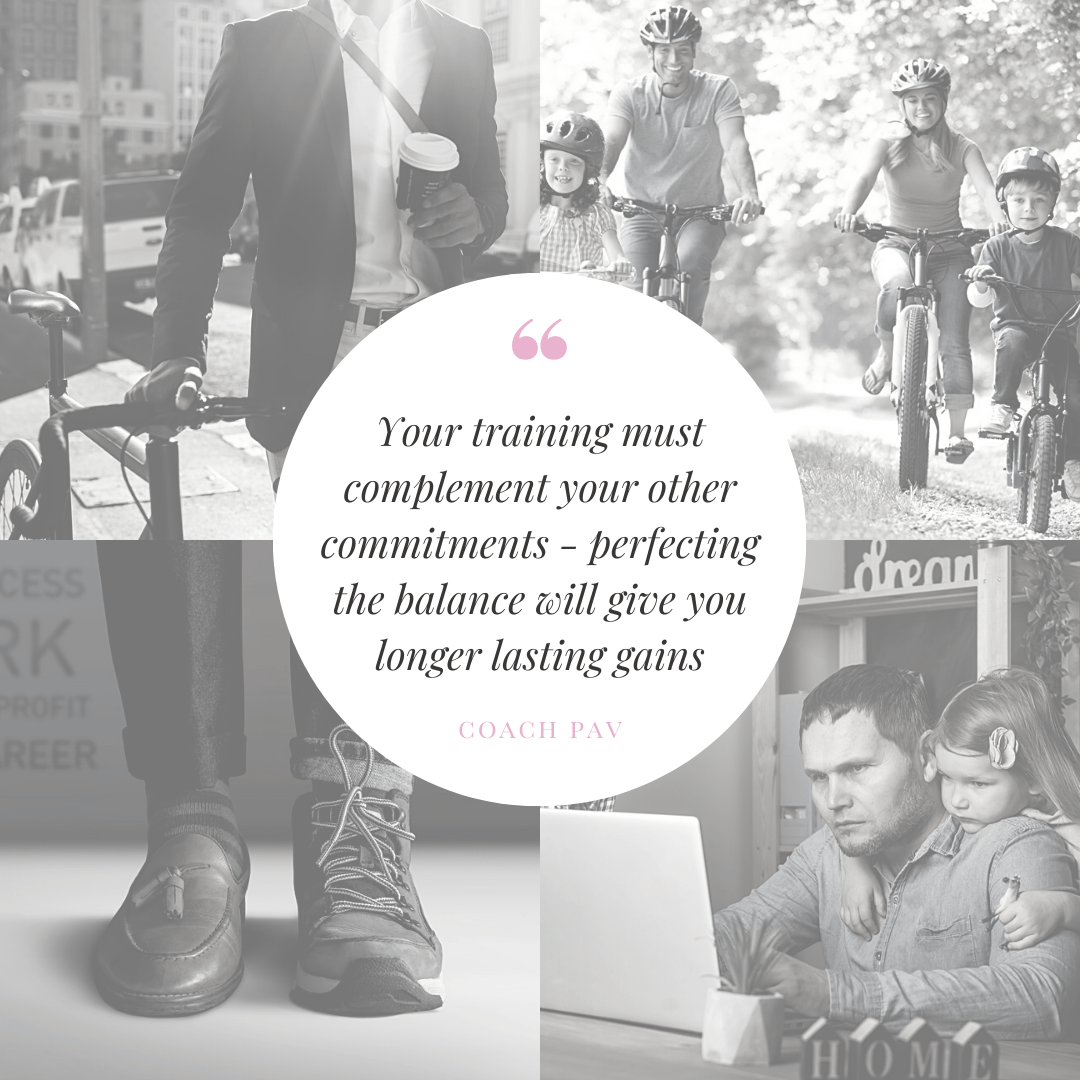
Balancing cycling training with work and family is something I have been pioneering in the amateur cycling training industry for many years. Unless you are a professional cyclist, or an athlete who needs to devote every fibre of their being to a specific goal, it is understandable that training cannot always be your number one priority. The key is to set a realistic commitment, protect the time you do have and avoid overcommitting yourself into failure.
Covered in this blog
- Why being amateur is harder than being a pro
- How to approach your training
- How to balance cycling training with work and family
- Commute
- Train at work
- Involve the family
- Get off your phone
- Anchor your day
Why being amateur is harder than being a pro
To give some context on this, I’ve worked with and know many professional cyclists and the ones who are now retired from racing say that the 10 hours a week training they do around their 40 hour a week job is far harder than the 30-40 hours per week they used to spend riding their bikes.
While your work might not be more important to you than your family, you will have a harder time adapting your training around it. It’s a lot more likely that your partner will look after the kids while you head out on a long ride, than your boss saying yes to you taking the afternoon off work.
With the average age to become a first time parent in the US now 26 for mothers and 31 for fathers, it’s easy to see how a family might not really interfere too much with a pro in comparison to an amateur. Of course pro bike riders have kids while still racing, but they’re already established in the sport. We are dealing with averages here, but my point is to simply show that as your commitments go up, your expectations around how many hours you can commit to riding your bike, might have to come down. It’s for this reason that I stress approaching your training with caution.

How to approach your training
Many cyclists (athletes) set their training high upon a pedestal, blinkered to the potential problems that might come later in time; busier work roles, changes in responsibilities, or family matters, are just a few examples of how in one moment you feel you can dedicate your whole life to cycling and then in the next you are virtually quitting. It might sound extreme, but the trouble is the likelihood of a cyclist quitting when they have this mentality and are faced with this problem is actually very high.
When I start working with a new client, I send them an intake questionnaire. One of the final questions is “how much they will commit to training” on a scale of 1-10. I often get keen cyclists telling me they are committed at level 10, but after a brief conversation where I explain what that actually means, they often back down slightly. This makes the conversation around accurately setting goals a lot easier. Ultimately, this isn’t about not chasing your dreams, it’s about being realistic with what you can chase. It’s better to readjust your goals slightly, than to not reach them entirely.

How to balance cycling training with work and family
My average client is training for a sportive or gran fondo, is in an executive management position, skilled tradesman, or self-employed. They are typically between the age 35 and 55, and have, or will have soon, young families. This means they are likely to train less than 8-10 hours per week, some even less.
A big part of my role as their coach is to ensure they are time efficient. I’m not looking to create crazy people rushing from one task to the next, but we might look at lifestyle or time audits together to see where there might be an extra 30 minutes or so. We then look at how we can incorporate additional training around the activities they already do. Here are my suggestions to help you find the perfect family, work, and training balance.
Commute
I’m torn with this. From a pure cycling performance perspective, I don’t recommend cyclists commute via bicycle. From an environmentalist point-of-view, I strongly recommend it. Often the decision for one of my clients to commute is based upon a number of factors, but for those who have very little time to train, a commute does present an opportunity to get some more time on the bike.
The cons of training during your commute are that it’s very difficult to control; terrain, traffic, weather, these influences make the training less compliant. The pros, of course, are that this type of training is better than nothing.
There are other logistical challenges too. If it’s torrentially raining, if your workplace lacks bicycle storage or a place to clear up, or you live too far or too close, you might struggle. If it’s an option for you, I’d recommend starting with 1-2 days per week. You will need to decide when best to complete the training itself too. On the way to work you might be fresher, but you may not have eaten properly. On the way home you might be more tired, but better fuelled. Again, testing a couple of different choices will help you establish the most effective way of training while commuting to work with your bicycle.
Train at work
Here’s one that is quite popular. If you have the opportunity to train at work – maybe an unused room where you can bring some equipment – this could solve some problems. You might consider coming in early and/or leaving later in the day to accommodate a bit more time to train at work. This could be further beneficial by allowing you to skip some rush hour traffic.
Convincing someone to allow you to store some equipment at your workplace might seem hard, but pitch it as something that will increase productivity. You might even be able to get your workplace to purchase some equipment for a small gym.

Involve the family
Involving your family in your training might seem tricky, depending on their age and ability. If you’re lucky enough to have a partner who can keep up on the bike, you can schedule rides with them. Spin classes are great as everyone is going at their own pace. You could even add additional bikes to your indoor setup and all train indoors together.
If this isn’t possible, consider involving your family when you cross train. Squat with your children on your shoulders, plank with a child on your back. Get creative to both give your workout a little more difficulty and get some quality family time in too.

Get off your phone
Reality check. How long have you been reading this? How long do you stare at your phone each day? How much time do you waste on social media? I bet it’s a fair bit!
The great news is, there’s no reason to stop. Just get on your indoor trainer and start a session while reading this blog. Probably best to keep your phone in your jersey pocket when outside though…
Anchor your day
As I mentioned before, auditing your time is a positive move towards finding more of it. Using a diary or calendar, mark in all your anchor responsibilities, work or the school run for example.
Then list out separately all the other tasks you need, or want, to perform, but don’t have to do at a specific time. Also note down any that might be flexible, coming into work early or leaving later in the day for example.
Then you can start to ‘tetris’ the heck out of your calendar, and, eventually, you’ll have your days laid out with everything to do on it. I strongly recommend you give this a go, it is very likely you’ll carve out some time by doing this.
Then the only thing left to do is to follow it. Phone prompts or alarms, and digital calendar prompts are great for helping with this.

Cycling training with work and family tips
Perfectly balancing cycling training with work and family is entirely possible, but you have to stop being a barrier to you getting on the bike. No more excuses! Just get training! Here are my top five places to look to find some additional cycling training time:
- Commute
- Train at work
- Involve the family
- Get off your phone
- Anchor your day
Summary
The right balance is not about finding endless extra hours. It is about being realistic, organised and making the time you have count. If you would like help building a training plan around your work and family commitments, Book a Free Consultation.