Last Updated on 21 August 2026:
Cycling base fitness is the foundation that allows you to ride longer, recover faster and handle harder training more effectively.
Whether your goal is to improve on Zwift, complete your first century or simply become a stronger cyclist, developing a solid aerobic base gives you the capacity to tolerate more training and sustain your performance for longer.
In this guide, I’ll explain what cycling base fitness actually means, why it matters, how to build it with both high and limited training volumes, and how to get more from your base phase without turning every ride into a monotonous slog.
Covered in this blog:
- General understanding of how to build base fitness
- Why you should be building base fitness
- How to build base fitness
- With more than 15 hours per week
- With less than 10 hours per week
- Getting the most from base training
- Focus points
- Enjoyment
- Socialising
General understanding of how to build base fitness
Typically, you will build your base in two ways. The first, more traditional, way is to spend long periods of time on the bike at a low intensity – often referred to simply as base training. This approach might be the most effective way to build your base fitness, but requires a fair chunk of time (>~20 hours per week). Most of us amateurs just don’t have that amount of time.
The second, increasingly more popular, method of building base fitness is to cheat slightly and up the intensity. This is referred to as threshold or sweetspot training. This way is far more effective at building base fitness when you have less time. It’s not exactly the same, but there’s really little point to spending short periods of time (less than 6 hours per week) at low intensity.

Why you should be building base fitness
Asides from the benefits discussed above, building a solid cycling base fitness will aid your body in utilising fat as a fuel source and increasing your lactate threshold 1 (LT1).
Something even the leanest of us have is an almost unlimited supply of fuel, stored as fat. The challenge, however, is how our body can access that. If your body converts the fat to glycogen quick enough, it simply turns to glycogen stored in muscles as fuel. Given we have a limited source of glycogen in our body, it is smart to train our body to fuel at a higher intensity, for longer periods of time, on fat.
Regardless of whether your body is fueled with fat or glycogen, your body also needs to transport oxygen around to your muscles. Training to improve your base fitness will also increase your body’s ability to transport oxygen.
Your LT1 is the specific exercise intensity (power or heart rate) where your body produces lactate faster than it can clear it. Having a high LT1 will mean you can ride very long durations at quite a high power, heart, and speed.
How to build base fitness
When I’m working with clients, I often decide which base building methodology to follow depending on the amount of time they have available. If they have less than six hours, I’m probably going with threshold or sweetspot training. If the athlete has more than twelve hours (which is very rare), I might stick with a polarised method.
The tricky part can be determining what you do when someone is in the middle or close. Often I lean more towards a pyramidal approach in these circumstances, but correctly assessing both the athlete and their goals will help determine the exact outcome.

With more than 12 hours per week
With more than 12 hours of training time per week to build your cycling base fitness, you will want to have the vast majority of this at a low intensity. You might include 1-2 workouts that incorporate some high intensity interval, something like VO2Max. If you’re used to using power zones set to Functional Threshold Power (FTP), then the majority of your training is in zone 2 and 56-75% of your FTP. For those more used to following Functional Threshold Heart Rate (FTHR), you will be training between 69-83% of your FTHR. And if you don’t use either or have no clue what I’m talking about, you should be feeling no more than 3-4 on a scale of 10. You should be breathing naturally, being able to hold a conversation.
Aside from being consistent, one of my main focus points when working with clients is to ensure their training progresses. Even if you do have 20 hours per week, it’s not always wise to go from no training to the full 20. Leaving some room for progression will ensure your body copes, recovers, and adapts well. Even at this low intensity, I would also recommend taking an easy week every 3-4 weeks.
A typical base ride might last at least 3 hours, but you could start with as little as 90 minutes to 2 hours, and build from there. Don’t worry about counting the miles, you’ll be moving slow and you will probably have to deal with weather conditions and variable terrain, which will make focusing on how many miles you do an unwanted distraction. Focus instead on the time in the saddle. If you’re doing your base training indoors, you might consider breaking the ride up, turning off ERG mode, and simulating the road more closely. If you decide you want to hold a specific power for the full duration of your ride, you might want to decrease the duration as this is a considerable effort, even at low intensity.

With less than 6 hours per week
With less than 6 hours of training time per week to build your cycling base fitness, you will want to have the vast majority of this at a higher intensity, yet still aerobic (where your body is using oxygen when supplying fuel to your muscles). If you’re used to using power zones set to Functional Threshold Power (FTP), then this is often referred to as the sweetspot and is 88-93% of your FTP. For those of you who are more used to following Functional Threshold Heart Rate (FTHR), you will be training between 88-93% of your FTHR. As with low intensity training, if you don’t use either or have no clue what I’m talking about, this will feel about 6-8 on a scale of 10. You should be challenged by the end of the session or intervals, and conversation might be hard to have.
Training at this intensity can be useful, when used correctly. It tends to be less fatiguing than simply training at your FTP and still produces some similar adaptations to training long periods at low intensity. You might also factor in what your goal is. If you’re racing, especially short time trials or crits lasting less than one hour, then a low intensity base phase might not be best for you anyway. Training at the duration of your event is highly specific and will aid your performance.

Getting the most from base training
There’s a lot more to base training than just power, heart rate, perceived exertion, and adaptation. Each base ride is an opportunity to practise some of the process goals that will help you be more successful at reaching your goals. Of course, this will depend a fair amount on whether you are riding indoors versus outside, and at what intensity you are building your base, but here are my top four focus points to add real value to your base training.
- Position. A good time to tinker with your bike setup, try new parts or gear. Practise holding an aero position, and identifying power gains for changing your position. I recommend yearly bike fits, this is a good opportunity to identify areas for improvement
- Feeding and hydration. How good is your fueling plan? If you are training for longer events, such as gran fondos, you could spend the time practising your sportive nutrition plan
- Pacing. Can you pace to how your body feels? Can you hold a specific wattage or heart rate for an extended period? Base rides are a great opportunity to practise this, just turn ERG mode off if you’re inside.
- Technique. How is your pedalling efficiency? Can you demonstrate efficient climbing technique? Can you eat and drink on the bike while riding? Write down a list of what you need to work on and, safely, practise them on your base rides.
Enjoyment
You should be getting a huge amount of enjoyment from riding your bike, if not, you might be doing something wrong!
Head out and find a new route, take a trip somewhere you’ve never been, put your cycling computer in your jersey pocket and ride more freely. Whatever you do, base rides are a great opportunity to really remind yourself about how amazing riding a bike actually is.
Socialising
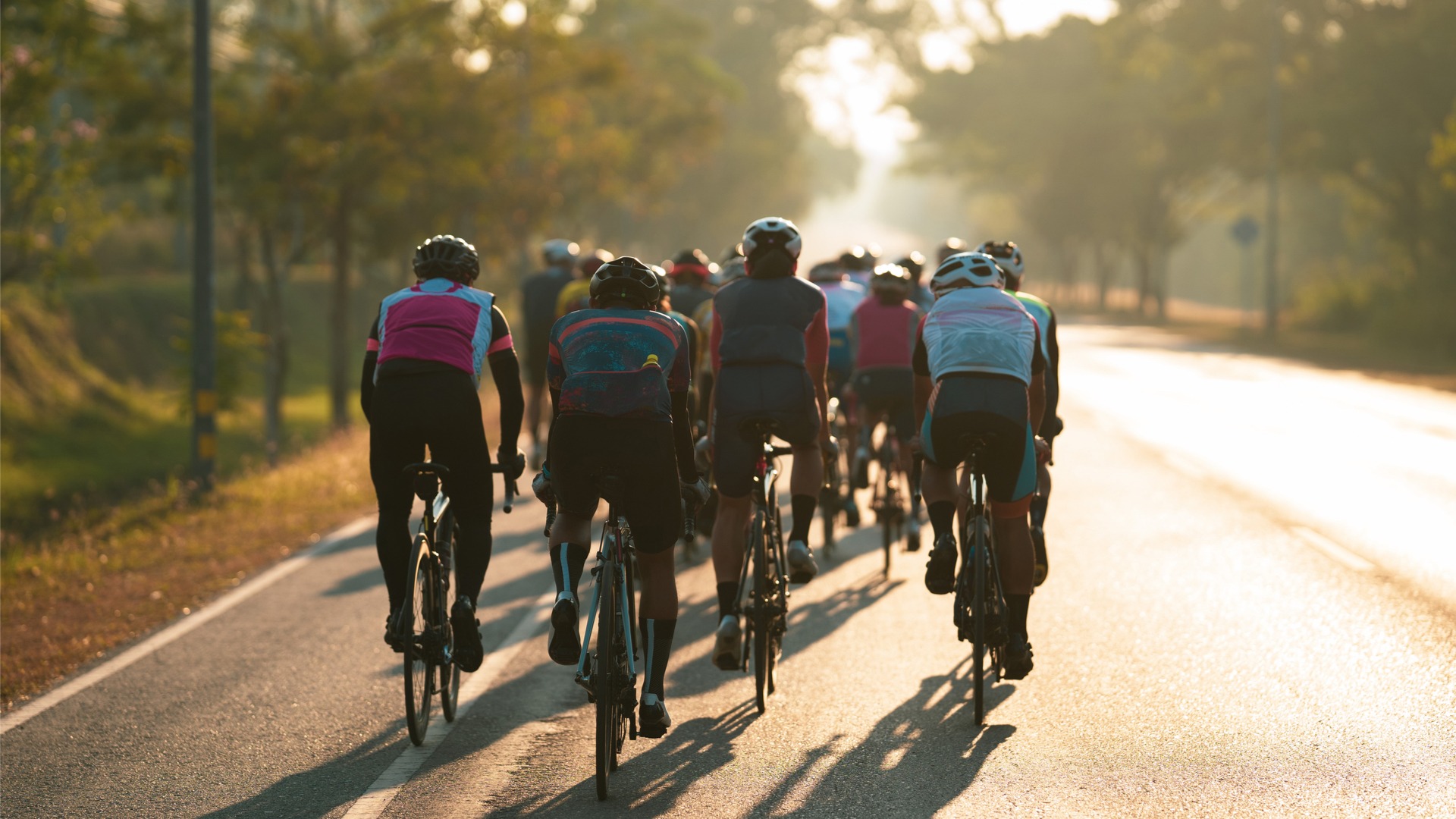
I do recommend that the athletes I coach spend some time socialising on the bike. Club rides, cafe stops, coffee and cake, they all make a regular appearance on my athletes coaching plans.
It can be an opportunity for you to meet new people, ride new routes, join a new club, and feel that sense of camaraderie that we, as humans, crave.
Summary
Improving your cycling base fitness is not simply about accumulating as many slow miles as possible. The right approach depends on how much time you have available, your current fitness and what you are preparing for.
If you have plenty of training time, longer low-intensity rides can provide a strong aerobic stimulus. If your weekly training time is limited, you may need to be more strategic about how you combine endurance work with appropriate amounts of intensity.
The most important thing is consistency. A well-developed base gives you something to build on when training becomes more specific and intense later in the season.
If you would like help building your cycling base fitness around the time you actually have available and the demands of your target events, book a free consultation.