Last Updated on 15 September 2026:
Cycling performance is not only shaped by the training you do, your nutrition or your tactics. Mental fitness for cyclists matters just as much: how you approach commitment, stress, setbacks and difficult efforts can influence what you are able to get from your training. For many years, I’ve advocated looking at cyclists holistically and helping them become more complete riders.
Covered in this blog
- The basics of mental fitness training
- Commitment
- Goal setting
- Balance
- Stress
- General mental health
- Improving your mental fitness
- Meditation
- Affirmations
- Mantra and power words
- Visualisation
- Visuals
- Music
- Attitude
- Positivity and gratitude
- Top tips for improving your mental fitness
The basics of mental fitness for cyclists
The first point in learning about mental fitness for cyclists is to understand is that we are all individuals and, as such, your experience of something in life might be completely different to someone else’s. Some of these points you might resonate with, others you might not. Either way, read on with as an open mind as possible.
Commitment
I’ve written and spoken about my thoughts on accurately gauging commitment many times. One of the first questions I ask someone who wishes to be coached by me is “how committed are you?”. Many will say 10 out of 10, until we discuss what that means. A full on 10 would mean they’d need to be perfect with their diet, that they likely train indoors year round, and that they will have to ditch their riding buddies for the duration of our coach and client relationship. Having had that conversation, they usually back down a little.
Setting unrealistic expectations of how dedicated you can actually be to your cycling training, will create a devastating effect if you don’t follow them. Allowing some freedom and flexibility in your training will reap many rewards longer term – especially when you stop considering not following the plan as “cheating”.
Ultimately, if you’re training for something near impossible for you, are a professional rider, or are hoping to become one, you might need to sacrifice a lot to reach your goals. However, the rest of us can be safe in the knowledge that, almost, every goal will be completely achievable, even with a little deviation from perfection.

Goal setting
You may have read that last chapter and thought “sh**!”. This is where the importance of goal setting for your cycling training comes in. It is wise to spend some time being objective and honest with yourself when setting your goals. It’s why working with a professional coach is key, it’s better and easier to adjust those goals day one of training, than t-minus one day from your event.
That’s not to say you shouldn’t dream big! I encourage my clients to have high dreams, just with realistic expectations and without setting themselves up for bigger, motivational related, challenges later on.
Balance
Finding the perfect family, work, and cycling training balance is another fundamental factor of your mental fitness. While this might apply more to those who work 40+ hours per week, have young families, or have many other responsibilities, ensuring that training is synergistic with life is important.
When training doesn’t fit with work, it often becomes something challenging to complete. In time these challenges will eventually become a burden. From there you are on a fast track to quitting. I spend a fair chunk of my time with clients, helping them complete lifestyle audits and work out where we can both squeeze more bike time in, and making sure that nothing else suffers.

Stress
Stress destroys your cycling performance. Some humans can have a long and challenging day, yet get home and smash an indoor training session with relative ease, perhaps utilising that pent up tension to put in a good performance on the bike. However, some people struggle with putting anything noteworthy in while stressed. The trouble is, we tend to flip flop between the two. As more stress builds, as we struggle to cope with it, or we experience it for too long, it becomes impossible to manage. Reducing stress triggers, and learning coping mechanisms, are the best ways to resolve this.
General mental fitness for cyclists
All the above factors are multiplied if you have general mental health challenges. Looking at your cycling training with an eye on any mental health challenges is a wise move to ensure you don’t slip into any chronic illness.
Factors such as your sleep, nutrition, support, relaxation, and grace with yourself, all contribute to positive mental health. In general, the athletes I coach who take active steps towards better general health, are the athletes who not only smash their goals, but reach far beyond them.

Improving mental fitness for cyclists
Meditation
Having been used by many cultures for thousands of years, it’s great to see this becoming a bigger part of ‘normal’ life in western societies. While this might seem alien to some, I can guarantee that if you buy into and commit to a structured meditation practice, you will see unbelievable gains.
Of course, the challenge with this is how subjective the gains actually are, and how long it might take for you to even notice them. Typically, the clients I introduce meditation to, report a greater acceptance of emotion and far lesser reaction to it. On first reading this, it might be easier to see how this would have a positive effect on general life and it would. To give it an athletic context, my clients who meditate regularly say their experience of challenging times on the bike, or suffering, is actually a lot better. That’s not to say that it’s any easier, but it’s more like a feeling of acceptance that this isn’t going to be easy, but you might as well get on with it!
For those who don’t know where to start, I recommend guided meditation apps such as Headspace, Calm, and Balance. Start by setting aside just 10 minutes per day, but try to increase this. Perfect times to meditate are upon waking and before bedtime, but if you can fit a midday session in, all the better.

Affirmations
This is something we are loosely taught as children, probably during sports. We might have been told to tell ourselves that we are capable of winning in order to boost our confidence. This is a simple example of an affirmation. Affirmations help by adjusting our mindset on the topics we practice on.
Ideally, you will write down 10-20 short sentences on what you want yourself to become. Here are my top affirmations for boosting cycling performance:
- I am dedicated and excited to train
- I am an amazing cyclist
- I am a strong cyclist
- I have incredible stamina
- I am committed to my cycling training
- I am a highly skilled cyclist
I also recommend picking some non-cycling related affirmations. You might have some challenges at work or at home, adding a few affirmations might really help you strengthen some areas where your mind wobbles a bit.
“Whether you think you will succeed or you think you won’t, you are right”. Henry Ford.
For no more cost than several minutes per day, you can really start to rewire your brain and make some huge differences in both life and cycling training (& competing) performance.
Mantra and power words
This should be fairly easy for me to convince you:
“Shut up, legs!” Jens Voigt
You may have heard of the above quote from cycling legend Jens Voigt. He is the perfect example of someone who uses mantra or power words to boost his mentality, especially when times are hard and he is suffering.
Personally, I usually shout. There’s something really primal about that for me. When I’m in the hurt locker, letting out a roar really helps focus me, gives me confidence, and pushes me on. Of course, not everyone around me appreciates it…
Find some words that resonate with you; it’s crucial that the words inspire and motivate you. Something as simple as “power, power, power” might be enough, and you don’t have to shout it either! Next time you’re pushing through the pain barrier, just say these words. As long as you keep saying them during tough times, and you keep pushing on, eventually they’ll become your go to when times are hard.

Visualisation
Visuals
Visuals/visualisation work in two ways. The first is more reactive and this might include you visualising yourself winning a race or crossing the finish line of your sportive or gran fondo. This can be incredibly powerful if you have an emotional attachment to the outcome, for example, you’re raising money for charity, or if this is your “A” event – in which case you should be passionate about finishing it! This is something I use often with my clients, especially those doing longer rides, multi-day, or anything considered ultra distance. In training, when they start to find it tough, I will get them to visualise how they will feel once they’ve completed their event.
The second way is more proactive and involves us using pictures to build motivation. I often get my clients to print pictures of what inspires them; this might be a partner, children, charity, even their event or goal. Once they have their pictures, I will get them to hang them strategically where they need motivation the most. This might be the first thing in the morning to get them on the bike, it might be on the snack drawer of the fridge to focus them on eating right. An easy example of this might be creating a dream or vision board. A dream board is a collage of everything you want to achieve. You hang it somewhere prominent that you’ll see frequently to boost your motivation towards actually achieving them.
Essentially, with both these visualisation methods, we are looking to promote an emotional response which will boost motivation.
Music
Possibly not always considered part of ‘visualisation’, but I’m including it here as I often utilize music, with my clients, in a similar manner.
I have no doubt that you’ve got songs that get your heart racing, your focus increasing, and your energy rising. With most of my clients, we will discuss playlist creation for the same two reasons as visuals. The first being to play something (even humming in their head) when they start to struggle. The second being more to get them ready for training or competing. Having a playlist and listening to it in your warm-up is a great way to start this process and test it out.

Attitude
If you’ve read my book, “The Guide to Truly Effective Cycling”, you’ll know that I believe that the training you actually complete only counts for around 15% of your end gains. Nutrition makes up around 35% and the other 50% comes from your mentality, a lot of this being your attitude towards training and your end events.
It won’t make much difference what you eat or how smart you train if your mind is going to crack as soon as it gets hard or whenever you have to put the effort in. We certainly don’t want this to become a burden, and it can be very challenging to teach yourself this kind of discipline, but if you’ve ever wondered why your cycling performance doesn’t seem to be improving or why you can’t lose weight, this is probably why.
Let’s start with how you view your training. The clients who I coach who make the biggest improvements are the ones who are most compliant, who always feedback information and keep regular communication open, treat every setback as an opportunity to learn, and understand that they’re only human, but if they show up every day with the right attitude, they will continue to improve.
The bottom line is that the cyclists who improve their performance the most are the ones with little to zero excuses, and keep coming back. If you make a mistake, that’s ok, just use it as motivation to be better next time. You only really lose when you quit.
Positivity and gratitude
This isn’t simply optimism. To be a successful cyclist you don’t need to only view the world as rainbows and unicorns. However, focusing on the positives will help you appreciate where you are more.
To get you started with this I’d recommend a gratitude practise. This can be something as simple as spending a few minutes every day mentioning what you are most grateful for. It could be using a journal to note down the best parts of your day or you could start a gratitude jar, filling it with three things you are grateful for every day.
Eventually, your mentality will shift to being more positive and being thankful for what you do have (for example the training you managed to smash) rather than focusing on what you don’t have (the training you didn’t complete perfectly). This will help you change the way your brain reacts to certain situations. You’ll no longer fear hills or time trials, training hard or long, and once you remove that mental barrier you’ll attain your potential far quicker.
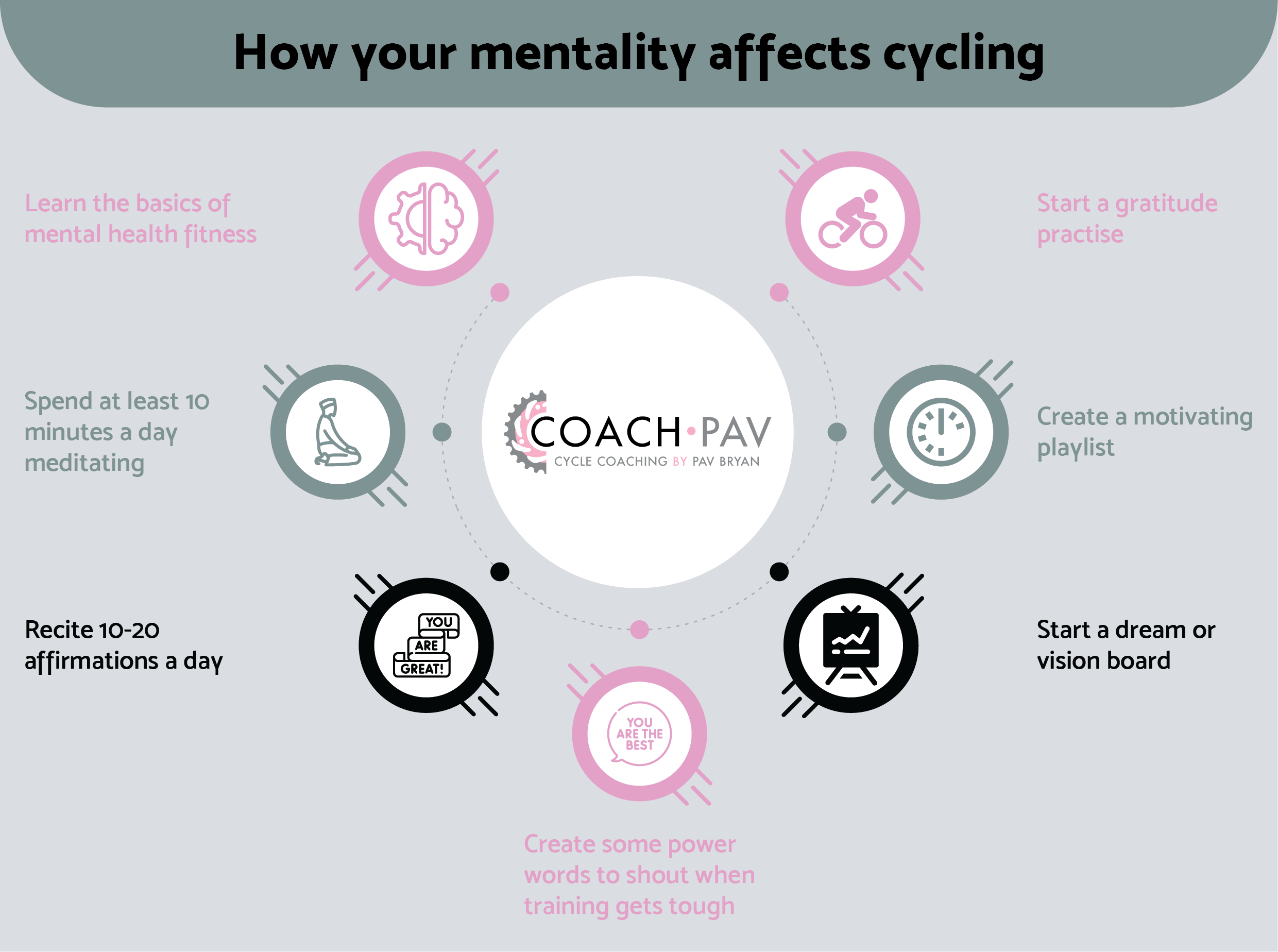
Top tips for improving mental fitness for cyclists
15% training, 35% nutrition, 50% mentality. We only function at a fraction of our capacity, start to unlock yours and see significant improvements in your cycling performance with these top tips:
- Learn the basics of mental fitness for cyclists
- Spend at least 10 minutes a day meditating
- Recite 10-20 affirmations a day
- Create some power words to shout when training gets tough
- Start a dream or vision board
- Create a motivating playlist
- Start a gratitude practise
Summary
Mental fitness is not about being perfect or positive all the time. It is about building practical habits that help you show up, manage setbacks and keep moving towards your goals. If you would like help making your training fit your life and ambitions, Book a Free Consultation.