Last Updated on 21 August 2026:
Stress and cycling performance are more closely connected than many cyclists realise. Training stress is necessary if you want to improve, but when it is combined with work pressure, poor sleep, family commitments and other demands, the total load can quickly become more than your body is able to recover from.
That can affect far more than how motivated you feel. Persistent stress can influence recovery, sleep, perceived effort and your ability to complete quality training consistently.
In this article, I’ll explain the relationship between stress and cycling performance, the different types of stress cyclists experience, and how recognising your overall stress load can help you make better training decisions.
Covered in this blog:
- Stress and cycling performance
- Acute stress
- Chronic stress
- Training stress
- What to do with stress
- Destressing
- Rest and relaxation
- Meditation
- Individualisation
- Top tips for dealing with stress
Stress and cycling performance
Remind yourself of the last time you had a really stressful day. A day when you felt you were being crushed, as if almost the entire weight of the world was bearing down on you. Where you were totally overwhelmed and almost paralysed by every challenge you had to face; with seemingly no end in sight. How well did you train when you felt like this…?
Acute stress and cycling performance
Acute stress can be brought on by something major happening; job interviews, first dates, meeting your partner’s parents for the first time. It typically comes on quickly, then disappears nearly just as fast.
It’s this type of stress that most people can turn into a positive. For example, you get into a little argument with someone and then smash an unbelievable cycling interval session. For most people, this type of stress isn’t too much of an issue.

Chronic stress and cycling performance
Chronic stress is the more dangerous stress, and the one I was referring to in my opening paragraph. This will come on gradually, almost completely unnoticed, and can lead to significant mental and physical health challenges. Factors that might contribute to this include unhappy relationships, work related problems, and longer term issues we tend to ignore and not deal with.
It’s this type of stress that – not only takes a huge toll on mental and physical health, and day-to-day life – kills your cycling performance. When you suffer from chronic stress, you are highly unlikely to find training enjoyable, even the thought of training for your event increases the stress you are under, and, in reality, you are highly likely to stop training altogether.
Training stress and cycling performance
If you’re a regular reader of my blog posts, you will know I talk about the stress that training places on your body and mind too. This type of stress tends to be acute, as you will recover from it, but can lead to chronic problems if you fail to recover from it. I mention this in this article simply to help you visualise how training can become challenging when you’re stressed – you will naturally want to avoid adding any more stress to your mind and body.

What to do with stress and cycling performance
Therein lies the challenge! Trying to simply stop being stressed is unrealistic; you need to feel stress to be motivated to do things such as work and earn money. Stress might even be the reason why you actually start cycling training for a big event. Yet we still need to find ways in which we can deal with that stress.
If you’re really stressed, the first thing you might do is a sort of emergency stop. Take a break from work, talk to your family about a vacation, take any other short breaks from the main stressors. This will give your body and mind some time to heal, wherein you can create your plan on how to move forward.
Destressing
Rest and relaxation
The all-time legends of cycling are hardly famous for their down time, but the professionals get to focus on just two factors: riding their bike, and resting. For us mere mortals, training has to be integrated into normal life. Even if you do find the perfect work, family, training balance, you still have to find time to rest and relax.
Rest and relaxation isn’t just about your sleep – although optimising your sleep will improve your cycling performance – it’s about finding periods throughout your day to just stop and take a brief break.
One of my biggest factors, that I feel we are all guilty of getting wrong, is socialising with good people. I write “good people” because I thoroughly agree with the saying “you become the average of the five people you hang around with most”. If you hang around with people who are constantly complaining, miserable, and just negative, guess what you become? Find your tribe, the people you love spending time with, and just relax in their company.

Meditation
I’ve been a huge fan of meditation for many years now because I believe it’s probably one of the simplest ways to start to manage your stress. Just ten minutes per day with guided meditation on an app such as Headspace, Calm, or Balance, might change your life. It helps teach you mindfulness and acceptance of your emotions and feelings.
I recommend it to all my clients who struggle with mental health challenges, such as stress, and the ones who openly try meditation over a longer period are the ones who see the most significant improvements in both performance and overall wellbeing.
For example, many of my athletes comment that performance testing still feels similar, but they have more acceptance of it, and are able to push through mental barriers, thus vastly improving their performance.
To get you started, why not take a few moments every day to practise this breathing technique:
- Sit or lie flat in a comfortable position
- Put your left hand on your stomach and your right hand on your heart
- Take a deep breath in through your nose, letting your stomach push your hand out
- Breathe out slowly through pursed lips as if you were whistling
- Do this just 3 to 10 times

Individualisation
Of course, you have to be open to implementing a new relaxation routine. If the thought of sitting quietly in meditation for ten minutes stresses you out further, you’re just not ready for it.
It’s very important that you find your own personal taste of rest and recovery. Think about what takes your mind away from the stresses of everyday life. Perhaps going out for a walk in the countryside works well for you.
Whatever you decide to do, consider this a lifestyle change. Anything less than that will only be temporary. Forming a habit around your new routine, will be the fastest and most effective way to long term relaxing. Just commit to it day-by-day.
Of course, if this seems too much, always ask for a helping hand. A professional coach who is an expert in personalising training to each athlete, will be a worthwhile investment.
Top tips for managing stress and cycling performance
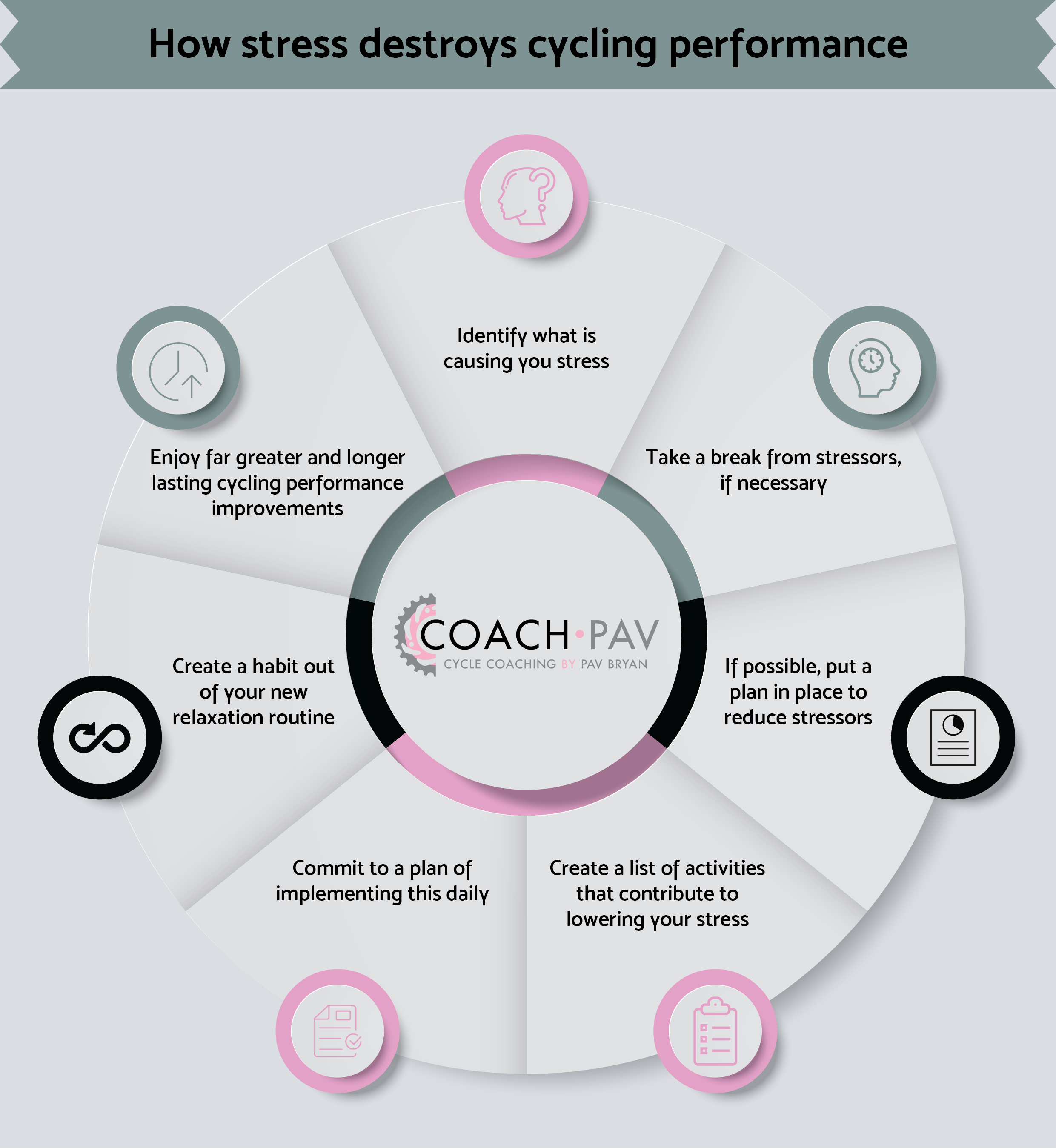
While it might feel overwhelming to implement anything new into your already busy routine, especially if you’re stressed right now, tackling this head-on will really help improve your quality of life, thus allowing your body more chance to recover from the stresses of training. Here are my top tips for dealing with stress:
- Identify what is causing you stress
- Take a break from stressors, if necessary
- If possible, put a plan in place to reduce stressors
- Create a list of activities that contribute to lowering your stress
- Commit to a plan of implementing this daily
- Create a habit out of your new relaxation routine
- Enjoy far greater and longer lasting cycling performance improvements
Summary
Managing stress and cycling performance is ultimately about recognising that your body does not separate training stress from everything else happening in your life.
A demanding workout might be completely appropriate during a calm week, but the same session can become an unnecessary additional burden when work is intense, sleep is poor or life outside cycling is already taking a lot out of you.
That is why good training should be adaptable. Sometimes progressing means pushing harder, but at other times the smartest decision is to reduce the load, prioritise recovery and allow yourself to absorb the training you have already completed.
If you would like help building a personalised cycling plan that adapts around your training, recovery and the stresses of everyday life, book a free consultation.