Last Updated on 21 August 2026:
Paris-Brest-Paris training needs to prepare you for far more than simply riding 1,200 km. Held every four years, this legendary journey from Paris to Brest and back demands endurance, pacing, fuelling, sleep management, reliable equipment and the ability to keep making good decisions deep into fatigue.
With the next Paris-Brest-Paris taking place in 2027, riders considering the event should also understand the qualification process and use it as part of their preparation rather than treating it as a separate hurdle.
In this guide, I’ll explain how to qualify, how to structure your Paris-Brest-Paris training, and the practical strategies that can help turn months of preparation into a successful finish.
Covered in this blog:
- Understanding Paris-Brest-Paris
- Qualifying for Paris-Brest-Paris
- Training for Paris-Brest-Paris
- Nutrition and hydration
- Gear and bike setup
- Strategy for success
- Mental strength
- Summary
Understanding Paris-Brest-Paris
The Paris-Brest-Paris was first held in 1891 and stands as one of the most respected and historic long-distance cycling events. It’s truly a cornerstone of the randonneuring community, attracting participants who embrace the spirit of endurance and self-sufficiency. Unlike a race, PBP isn’t about being the fastest; it’s about completing the route within the allocated time. Most riders strive to finish within 90 hours, but the official time limit varies depending on a rider’s chosen start group.
This event is legendary not only because of its difficulty but also because of the community it fosters. Riders from around the globe encourage each other, share stories, and push through highs and lows as they tackle endless kilometers and rolling hills. For many cyclists, the experience of riding PBP is as rewarding as finishing it, offering memories of camaraderie, mental challenges, and triumphs.
In summary
- Established: 1891, one of the oldest organized cycling events
- Distance: 1,200 km round trip
- Elevation gain: Approximately 11,000 meters
- Time limit: Usually 90 hours for the standard group
- Held: Every four years

Qualifying for Paris-Brest-Paris
To participate, you’ll need to prove your long-distance cycling credentials by completing a Super Randonneur (SR) series, which consists of four qualifying brevets. Each brevet must be completed within a certain time limit, and these rides increase in length over the course of the qualifying season (typically January to June). Riders must complete a 200 km, 300 km, 400 km, and 600 km brevet to qualify for PBP.
Completing these brevets isn’t only about building the necessary stamina; it’s also a way to hone your pacing, nutrition, and endurance strategies. Each ride provides a new level of preparation for PBP. You’ll learn how your body and mind respond to fatigue, how best to fuel over long distances, and how to manage any mechanical issues that come up. Each brevet is another opportunity to build mental resilience, as the journey to PBP is as much about mental strength as physical fitness.
To qualify
- Complete a 200 km brevet: Time limit of 13.5 hours
- Complete a 300 km brevet: Time limit of 20 hours
- Complete a 400 km brevet: Time limit of 27 hours
- Complete a 600 km brevet: Time limit of 40 hours
Paris-Brest-Paris training
Training for PBP requires a careful balance of endurance, pacing, and mental toughness. Unlike typical cycling training plans focused on high-intensity intervals, PBP training involves more steady, sustained riding to build endurance over long distances. This type of training emphasises the aerobic base, which means spending long hours at a comfortable pace to build up the stamina needed for up to 90 hours of riding.
Building your endurance base should start well before you tackle the qualifying brevets. Progressively increase the length of your rides each week, but keep the intensity manageable. If possible, practice back-to-back long rides over the weekend to mimic the extended efforts you’ll need for PBP. You can also incorporate hill training, as the PBP route has around 11,000 meters of elevation, which can take a toll if you’re not prepared.
In addition to physical training, prepare your mind. Riding for multiple days with minimal sleep is challenging, and your mindset will play a major role in your success. Consider doing some overnight or 24-hour rides to see how your body responds to fatigue, both physically and mentally. Learn how to talk yourself through tough patches, knowing that every rider hits those low moments.
Paris-Brest-Paris training tips:
- Build endurance: Focus on long, steady rides to build your aerobic base
- Hill training: Include hills in your training to prepare for the 11,000 meters of elevation
- Mental resilience: Practice overnight or long-duration rides to prepare for sleep deprivation
Nutrition and hydration
Eating and drinking well on a ride as long as PBP isn’t just a nice-to-have; it’s essential to your success. Because your body will be working continuously for hours on end, fuelling every hour is crucial. Find a balance between real foods and quick-energy options like energy bars or gels, as relying solely on sugary carbs can cause energy spikes and crashes. Eating a mix of carbs, proteins, and fats will help keep you feeling steady.
Your hydration plan is equally important. Carry electrolyte tablets or drink mixes to stay hydrated, and be mindful of water stops. PBP has frequent control points where food and water are available, but you’ll want to plan where you’ll refill to avoid running dry. Use your training rides to test different foods and hydration setups, as your body may respond differently during such a long event.
Nutrition and hydration takeaways
- Fuel regularly: Aim to eat every hour, mixing real foods with quick-energy options
- Stay hydrated: Carry electrolytes and plan water stops
- Practice your strategy: Test your nutrition on long training rides
Gear and bike setup
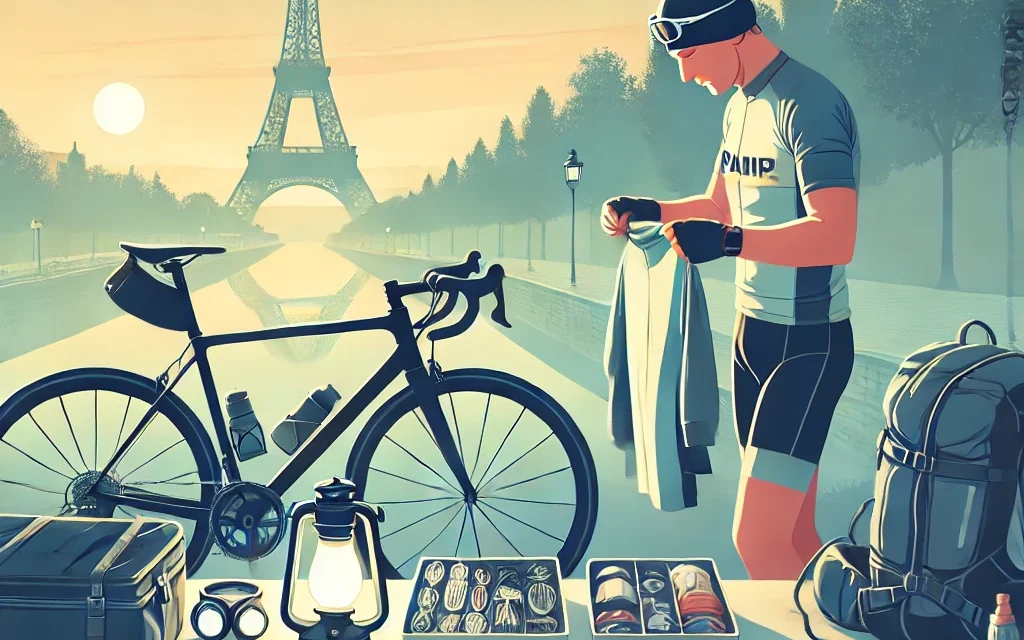
Your bike setup can make all the difference in a 1,200 km ride. While you might be tempted to go for a lighter bike, comfort should be your priority. A comfortable endurance bike is ideal, as its geometry allows you to stay relaxed and minimises fatigue. Opt for a saddle that you have rigorously tested in training, as you’ll be in it for many hours at a time. Experiment with ergonomic grips or even aerobars, if you’re comfortable with them, to provide additional hand positions.
Since PBP includes night riding, invest in a high-quality lighting system. Many riders use dynamo hubs for consistent power without worrying about batteries, but whatever setup you choose, make sure it’s dependable. Layered clothing is a must since the weather can change dramatically, and a reliable waterproof layer can make a big difference if you encounter rain.
Key gear points
- Choose comfort: Prioritize comfort over weight in your bike choice.
- Lighting: Invest in high-quality front and rear lights, with backup power if needed.
- Layer up: Dress in layers to handle varied weather.
Strategy for success
Having a plan for pacing, sleep, and mental stamina is essential for completing PBP within the time limit. While some riders try to power through with minimal sleep, most plan to sleep at control points, keeping these stops efficient to stay on track. Make use of the control points to get food, water, and rest, but aim to limit your time there to keep a steady pace.
Pacing is key—starting too fast can easily lead to burnout. Keep a sustainable pace from the start, knowing that it’s a long game. Many riders find it helpful to break the ride down mentally into smaller, manageable sections between control points, using each as a short-term goal.
Strategic tips
- Control stops: Use control points for food and rest but limit your time
- Sustainable pacing: Keep an even pace throughout, especially in the early stages
- Small goals: Break down the ride into segments to keep it manageable
The role of mental strength in Paris-Brest-Paris training
PBP is not just a test of physical endurance but also mental resilience. After many hours in the saddle, tiredness, soreness, and even self-doubt can creep in. Staying positive and focused on the finish line can make all the difference. Find motivation in the camaraderie, remind yourself why you’re there, and remember that every tough moment is temporary.
Breaking down the ride into smaller parts helps, as does visualising the finish. Remind yourself of the reward that awaits, and use that image as fuel. Riders often say that the hardest part is simply pushing through those challenging mental moments, so prepare yourself to keep going when your body and mind are weary.
Mental resilience points
- Stay positive: Focus on the reasons you wanted to complete PBP
- Break it down: Mentally divide the ride into smaller, achievable segments
- Visualise success: Picture the finish line to help push through tough moments
Summary
Paris-Brest-Paris training should prepare you for much more than covering 1,200 km. A successful ride depends on endurance, pacing, fuelling, sleep management, reliable equipment and the ability to keep making sensible decisions as fatigue builds.
The qualification rides are an important part of that preparation, but the strongest approach is to use them as stepping stones within a wider training plan that gradually develops the specific demands of PBP.
With Paris-Brest-Paris only taking place every four years, arriving at the start properly prepared gives you the best chance of making the most of the opportunity.
If Paris-Brest-Paris 2027 is on your calendar and you would like help building a personalised Paris-Brest-Paris training plan around the qualification series and the demands of the event itself, book a free consultation.