Last Updated on 14 September 2026:
Track cycling races combine raw speed, power and tactical awareness on the velodrome’s steeply banked curves. From explosive sprint events to endurance-based pursuits and team races, each format tests a different side of your riding. This guide explains how the main events work, what they demand and how to begin training for them.
Covered in this blog:
- Sprint
- Rules and format
- Training tips
- Keirin
- Rules and format
- Training tips
- Team sprint
- Rules and format
- Training tips
- Individual pursuit
- Rules and format
- Training tips
- Team pursuit
- Rules and format
- Training tips
- Omnium
- Rules and format
- Training tips
- Madison
- Rules and format
- Training tips
- Scratch race
- Rules and format
- Training tips
- How to get started in track cycling
Track cycling races: Sprint
The sprint is one of the most iconic events in track cycling, often described as a game of cat and mouse. While it may only last for three laps of the track, the tactics involved make it one of the most exciting races to watch and race.
In the sprint, two riders go head-to-head over 750 meters, but it’s not just a flat-out race from start to finish. In fact, the first two laps are often slow and tactical as each rider jockeys for the best position. The key is to get your opponent in a less advantageous spot, forcing them to make the first move, which leaves you free to draft behind them and then unleash your final burst of speed in the last lap.
To train for the sprint, the focus should be on short, explosive efforts that build power. Low cadence (big/heavy geared) high-intensity interval training (HIIT) sessions with sprints of 10-15 seconds, followed by plenty of rest, can develop the kind of leg speed and power needed to accelerate quickly. Beyond physical training, the sprint is all about strategy and bike handling, so practicing mock races with other riders will sharpen your ability to position yourself smartly and time your final sprint to perfection. Gym-based strength training, especially exercises like squats and deadlifts, will also help build the explosive leg power needed to dominate in this event.
Rules & format
- Two riders compete head-to-head over 3 laps (750 meters on a standard 250-meter track)
- The first two laps are often slow as riders try to outmanoeuvre each other, positioning themselves to take advantage of slipstreaming and sudden acceleration
- The final lap is where the real sprint happens, with both riders going all-out to cross the line first
Training tips
- Power and speed workouts: Sprints require explosive power. Focus on short, low cadence, high-intensity intervals (e.g., 10-15 second all-out efforts)
- Tactics practice: Work on positioning and acceleration timing. Partner up with other riders to practice your strategic moves
- Strength training: Incorporate gym work, especially leg strength (squats, deadlifts), to boost your sprint power

Track cycling races: Keirin
If you like the idea of sprinting but want a bit more chaos thrown in, then the Keirin is the race for you. This event originated in Japan and is now a fan favorite in track cycling competitions worldwide. In the Keirin, six to eight riders start behind a motorised pacer known as the derny, which gradually increases its speed over several laps before pulling off the track. Once the derny leaves the riders to it, it’s an all-out, no-holds-barred sprint to the finish line.
The Keirin is as much about tactical positioning and timing as it is about raw power. Riders often jockey for position behind the derny, trying to stay in the best draft while also watching for any sudden moves from their competitors. Once the derny leaves, it’s a frantic sprint, and things can get physical, with riders often elbow-to-elbow at speeds upwards of 70 km/h.
To prepare for Keirin races, you’ll need to train for explosive sprinting power similar to the individual sprint event, but also hone your skills at riding in tight packs. Practice riding at speed in group training sessions, getting comfortable with quick accelerations, and navigating the chaos of riders around you. You’ll also need to develop sharp reflexes and confidence in your bike handling to avoid collisions.
Rules & format
- 6-8 riders compete in a group behind a motorised pacer (the derny) which gradually increases speed before pulling off the track with about 2.5 laps remaining
- Once the derny exits, it’s an all-out sprint to the finish over the remaining laps
Training tips
- Group riding practice: Keirin races often get physical, so it’s essential to practice handling your bike in tight packs and at high speeds
- Explosive sprint training: Just like the sprint event, power is crucial, so focus on short, explosive intervals
- Race simulation: Simulate the pacing of a Keirin in training. Practice accelerating after riding behind a pacer
Track cycling races: Team sprint
The team sprint adds another layer of complexity by requiring three riders to work together in perfect harmony. Each rider leads for one lap, before peeling off to leave the next teammate to carry on the charge. The goal is for the last rider to complete three laps in the fastest possible time.
Team sprinting is all about coordination and teamwork. Unlike in the individual sprint, where tactics revolve around outsmarting a single competitor, here the focus is on maximising efficiency and aerodynamics as a team. The key is to ride as closely as possible to your teammates, drafting behind the lead rider to conserve energy. Timing the peel-off correctly is critical, as it can affect the team’s overall speed.
To train for the team sprint, work on short, high-intensity intervals to build the power necessary for each rider’s one-lap effort. However, this event also demands that you practice as a team, focusing on the smooth execution of transitions and maintaining close, aerodynamic positions behind the lead rider. Team sprinting requires not only individual strength but also the ability to execute seamless group tactics under pressure.
Rules & format
- Teams of three start together, and each rider leads for one lap before peeling off
- The goal is for the final rider to clock the fastest time after three laps
Training tips
- Team coordination: Synchronisation is key, so practice lead-outs and transitions. Riders need to know when and how to peel off efficiently
- Aerodynamics: Focus on staying low and efficient behind the lead rider to conserve energy
- Short power intervals: Each rider must execute a full-gas effort for their lap. Train with 1-lap or 30-second maximal efforts
Track cycling races: Individual pursuit
In the individual pursuit, two riders start on opposite sides of the track, aiming to catch their opponent or set the fastest time over a distance of 3 km for women and 4 km for men. It’s a race of sustained, high-speed effort that tests a rider’s endurance and pacing abilities.
The individual pursuit is all about sustained power and aerobic endurance. Riders must be able to hold a near-maximal effort for several minutes, all while maintaining their most aerodynamic position on the bike. Training for this event involves intervals at VO2Max intensity.
Riding in a low, aerodynamic tuck for extended periods is also crucial. Spending time in your time trial position during training sessions will help you become comfortable with the position and ensure you can maintain it when it matters most. As with any time trial-style race, pacing is key—going out too hard will likely lead to burnout, while starting too conservatively may leave you with no chance to make up the deficit.
Rules & format
- The race is either 4km (men) or 3km (women)
- Riders go against the clock and aim to complete the distance as quickly as possible. Catching the opponent ends the race
Training tips
- VO2Max work Since the pursuit requires sustained effort at high intensity, focus on VO2Max training
- Aerodynamic positioning Practice riding in your aero tuck position. Comfort and efficiency in this position are crucial for success
- Steady power output Develop the ability to hold a consistent power output over 3-4km efforts
Track cycling races: Team pursuit
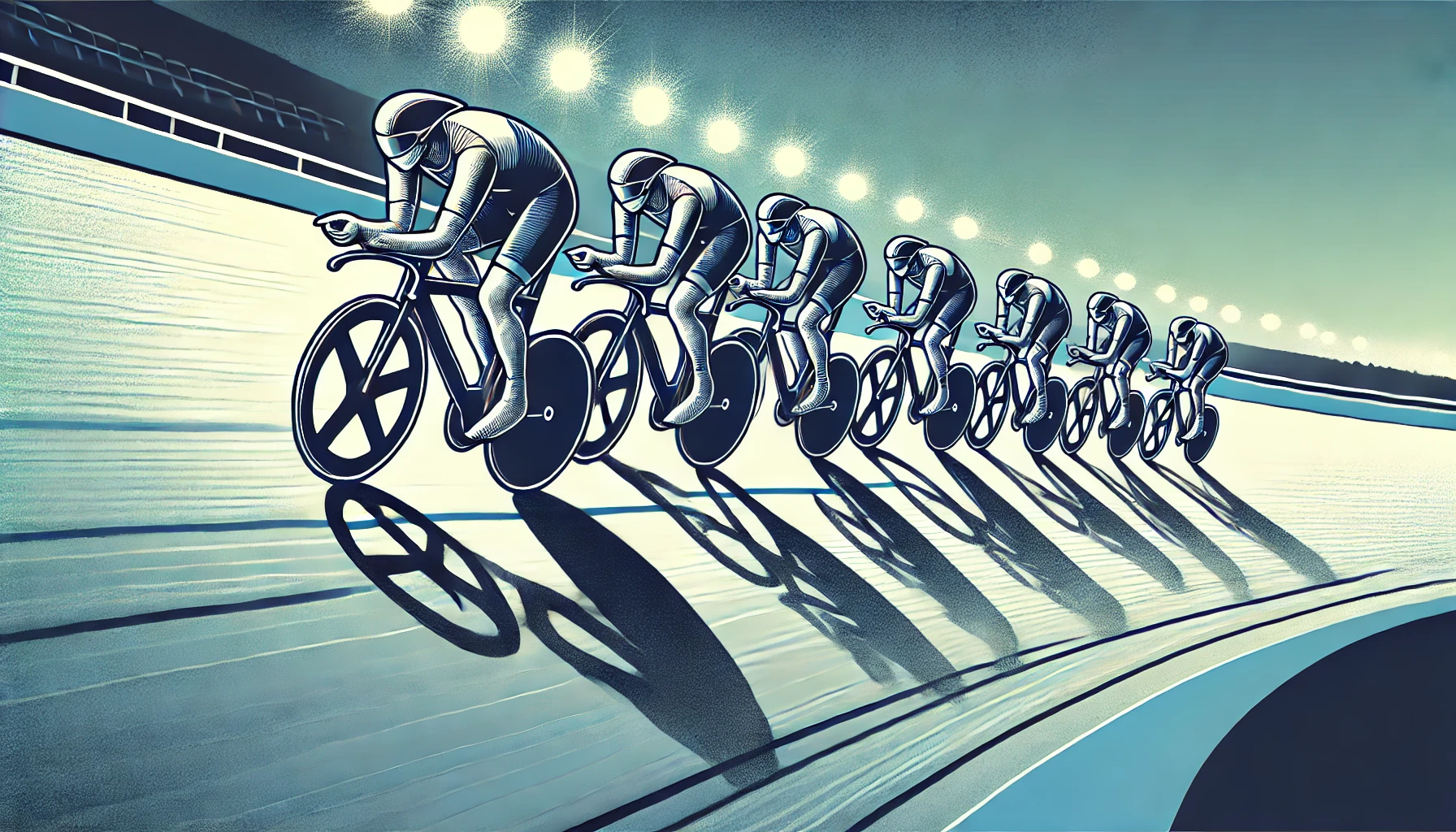
The team pursuit follows a similar format to the individual pursuit, but with teams of four riders working together to cover 4 km as quickly as possible. The team’s time is taken when the third rider crosses the finish line, meaning that at least three riders must work together in harmony for the entire race.
In team pursuit, the challenge lies in balancing speed and efficiency as a group. Riders take turns at the front of the group, peeling off after short pulls to allow a teammate to take the lead. Each rider must contribute to the overall pace without tiring themselves out too quickly.
Team pursuit training focuses heavily on endurance, team coordination, and drafting techniques. Teams need to practice their transitions, ensuring they lose minimal time during handovers. Riding smoothly and tightly as a unit can save precious seconds, so spending time working on group drills and race simulations is essential for success in this event.
Rules & format
- Teams of four compete over 4km, working together to post the fastest time
- The team’s time is taken when the third rider crosses the line, so three riders must finish together
Training tips
- Teamwork & drafting: Teams need to practice pacing, drafting, and smooth transitions to minimise energy loss
- VO2Max training: VO2Max intervals will help mimic the high-sustained efforts required for this event
- Aerodynamics & positioning: Like the individual pursuit, staying aerodynamic while riding fast is crucial
Track cycling races: Omnium
If you fancy yourself as an all-rounder, the omnium is the perfect test. This event is a multi-race competition, typically including the scratch race, tempo race, elimination race, and points race. Each race tests different skills, and the rider with the most cumulative points at the end of the day is crowned the winner.
The omnium requires riders to be adaptable and versatile, excelling across different types of racing. For example, the scratch race is a straightforward mass-start event where the first rider across the finish line wins, while the points race is all about accumulating points during intermediate sprints over a long distance.
Training for the omnium means preparing for a wide range of race conditions. Riders need to have a solid endurance base to handle longer races like the points race, but also the ability to sprint and react quickly during tactical moments in the elimination race. Omnium riders often train with a combination of interval work, endurance rides, and race simulations to sharpen both their physical fitness and tactical decision-making.
Rules & format
- Typically includes the scratch race, tempo race, elimination race, and points race, with points awarded based on finishing positions
- The rider with the most cumulative points after all events wins
Training tips
- All-round conditioning: Since the omnium involves a mix of sprints, endurance, and tactical races, work on both aerobic endurance and explosive power
- Race tactics: Each race format requires different strategies. Practice each race type separately to refine your tactics
- Recovery between races: Omnium events are spread over a single day. Practice riding hard, recovering quickly, and going again

Track cycling races: Madison
The Madison is one of the most complex and thrilling events in track cycling, with two riders working as a team to complete a set distance. One rider races at a time while the other recovers by riding around the top of the track. The most unique element of the Madison is the hand-sling exchange, where the active rider grabs their teammate’s hand and slings them into the race at high speed.
Madison races are often long, with intermediate sprints that award points throughout the race. Gaining laps on the field can also be a crucial strategy, as it can put you in contention for victory even if you don’t win the most sprints.
Training for the Madison involves practicing the hand-sling technique, which is essential for smooth transitions between teammates. You’ll also need to develop excellent endurance and tactical awareness; knowing when to go on the attack, when to rest, and how to position yourself for the critical sprints.
Rules & format
- Riders take turns racing while their partner recovers by riding around the top of the track
- Points are awarded for sprints during the race, with additional points for gaining laps on the field
Training tips
- Hand-sling practice: Mastering the hand-sling is critical, so make sure to practice exchanges with your teammate regularly
- Endurance training: Madison races can be long and chaotic, so a solid endurance base is crucial
- Tactical awareness: Learn how to read the race, position yourself well, and take advantage of opportunities to gain laps
Track cycling races: Scratch race
The scratch race is one of the simplest formats in track cycling: a mass-start race where the first rider to cross the line wins. It sounds straightforward, but the scratch race is often highly tactical, with riders jockeying for position throughout the race before launching their final sprint in the closing laps.
To succeed in a scratch race, you need a mix of endurance, sprinting power, and race craft. You must be able to maintain a strong pace over a relatively long distance (typically 15-20 km) while also having enough energy left to sprint to the finish. Training should focus on both long endurance rides and sprint work to ensure you can handle the race distance and finish strong.
Rules & format
- All riders start together, and the race is typically around 15-20 km. The first rider to complete the distance wins
Training tips
- Endurance and sprinting: You need the endurance to last the entire race and the sprint power to win in the final laps
- Tactical riding: Positioning yourself in the group and timing your final move is crucial. Practice pack riding and final-lap sprints
How to get started in track cycling racing
If track cycling sounds like something you’d like to try, it’s easier to get started than you might think. Here’s what you need to do:
- Find a velodrome: The first step is finding a velodrome near you. Many major cities now have indoor or outdoor velodromes, and most offer rental bikes, helmets, and even shoes if you don’t have your own. National Governing Bodies (such as British Cycling) are a great resource
- Sign up for a taster session: Velodromes typically offer taster sessions or beginner classes. These are designed to get you comfortable with the unique setup of track cycling—such as riding a fixed-gear bike with no brakes—and familiar with the track’s steep banks
- Join a local track league: Once you’ve gained some experience, you can look into joining a local track league. These leagues run regular races and training sessions, giving you the opportunity to race in a structured environment
- Invest in equipment: To begin with, you can rent a track bike from the velodrome, but if you want to commit to the sport, you’ll eventually want to invest in your own. Track bikes are simple but specialised, with a single fixed gear and no brakes. Make sure to invest in a proper helmet and cycling shoes too
- Work with a coach: Track cycling demands a mix of power, speed, and endurance. Following a coach-led training plan tailored to track cycling will help you improve quickly
Track cycling offers a rewarding challenge whether you enjoy explosive efforts, endurance racing or developing sharper race craft. If you would like help building training around your goals and available track time, Book a Free Consultation.