Last Updated on 19 November 2026:
How many carbs should you eat on the bike? Cycling nutrition for amateur cyclists starts with a more useful question: what do you need this ride to do for you?
If it’s an easy spin after breakfast, you can keep things simple. If it’s a hard workout squeezed in after work, what you ate at lunch might matter as much as what’s in your bottle. And if you’re riding a hilly sportive or an ultra, you’ll want a plan that still works when you’re tired, the weather changes and the next place to buy food is an hour away.
That’s what I took from the UCI Sports Nutrition Project position statement. The project brought together 54 researchers and 14 reviews on elite cycling, covering everything from fuelling and recovery to rider health. The part I’d bring straight into amateur coaching is how much the right strategy depends on the rider and the job in front of them.
Covered in this blog
- How to fuel your ride
- How many carbs per hour?
- What to eat before you ride
- How to make your fuelling plan work on the road
- Train your gut
- Plan your drinks and food stops
- What to eat between rides
- My five fuelling tips for your next key ride
- Summary
- Further reading
How to fuel your ride
The UCI statement synthesises research for elite cyclists across several disciplines. Professional road racing has its own demands, including repeated surges, long stages and ready access to food and drinks. That makes the race data useful context, with limited direct application to an amateur sportive or a self-supported overnight ultra. The ride examples below are my coaching applications of the evidence. Treat them as a baseline idea of nutrition for amateur cyclists and judge them by how you ride, how your stomach feels and how you recover.
How many carbs per hour?
The UCI’s road racing review describes pros taking in around 90 grams of carbohydrate per hour, and in some cases 120 grams or more. Those are reported racing intakes. A pro attacking repeatedly in a stage race has a very different job from someone riding steady endurance on Sunday. Even two riders doing the same sportive might need different plans depending on how hard they ride, what they tolerate and how long they’ll be out.
Here’s how I’d turn established sports nutrition guidance into something you can try this week. The durations are guides. How hard you ride and what you’ve eaten beforehand matters too.
- Easy spin around an hour. If you’ve eaten normally, water as needed and your usual meals may be plenty.
- Hard ride of about an hour. If it’s been several hours since lunch, try a familiar carb snack beforehand. A few sips of carb drink during the workout may also help, especially if eating beforehand was awkward.
- Endurance or harder ride of roughly 1–2½ hours. Use 30–60 g of carbs per hour as a starting range. Start where you’re comfortable and adjust based on the work you’re doing.
- Demanding sportive or long ride beyond roughly 2½–3 hours. If you already tolerate around 60 g per hour, you can practise working towards 90 g per hour when the effort warrants it. At higher intakes, try a mix of glucose or maltodextrin and fructose.
- All-day or overnight ultra. Start with the intake you’ve already held comfortably on a long training ride. Build the plan around your pace, food preferences, refill stops and what you can keep eating late in the ride.
Say you’re practising 60 g per hour. A bottle with 35 g of carbs plus a 25 g gel gets you there if you finish both within the hour. Check the labels and count what you actually take in. If it’s cool and you’re drinking less, carry some of those carbs separately so you can adjust your fluid without losing track of your fuel.
What to eat before you ride
For a weekend sportive, I’d have a familiar carb-rich breakfast a few hours before the start. Porridge and a banana or toast and jam are simple options. For a Tuesday workout after work, I’d focus on getting a proper lunch and having something easy to eat before the ride if lunch was early. The best option is the one you can fit into your day and digest comfortably.
On a longer ride, start eating early. If the first climb is an hour in, pick a safe stretch of road to eat beforehand. I’d rather get that first snack in while the pace is manageable than spend the climb trying to open a gel with my teeth.

How to make your fuelling plan work on the road
Train your gut
Pick one longer ride each week to practise. Start with an amount you can already tolerate, take it in smaller portions across the hour and write down how it went. Track what you ate and drank, how hard you rode, the weather and any symptoms. If it went well, change one thing next time. That might mean adding a little more carbohydrate, trying a different food or testing the same plan at event pace.
There’s some evidence that repeated feeding during exercise improves gut comfort and carbohydrate absorption for some athletes. The research is still limited. One systematic review found eight eligible studies with different approaches and outcomes, and most participants were male. I use gut training to find what works for the rider in front of me.
Plan your drinks and food stops
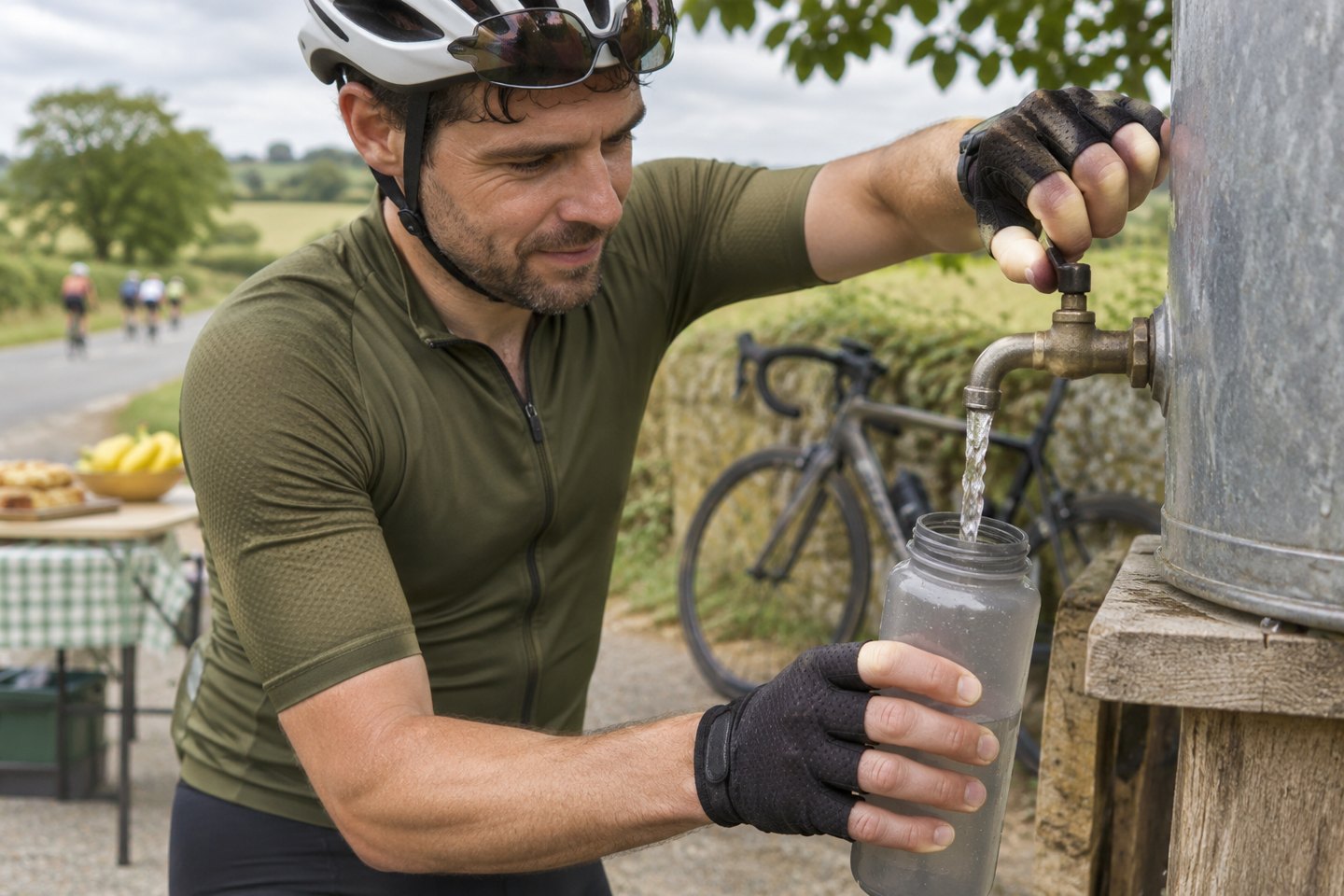
For a hot event, I’d look at where you can refill and how long the exposed sections will take. Practise in similar conditions if you can. How much you drink depends on the weather, your effort and how much you sweat. On a long, hot ride, a drink with sodium can be practical if you’re sweating heavily. Keep the plan flexible and avoid forcing fluid to meet an arbitrary bottle target.
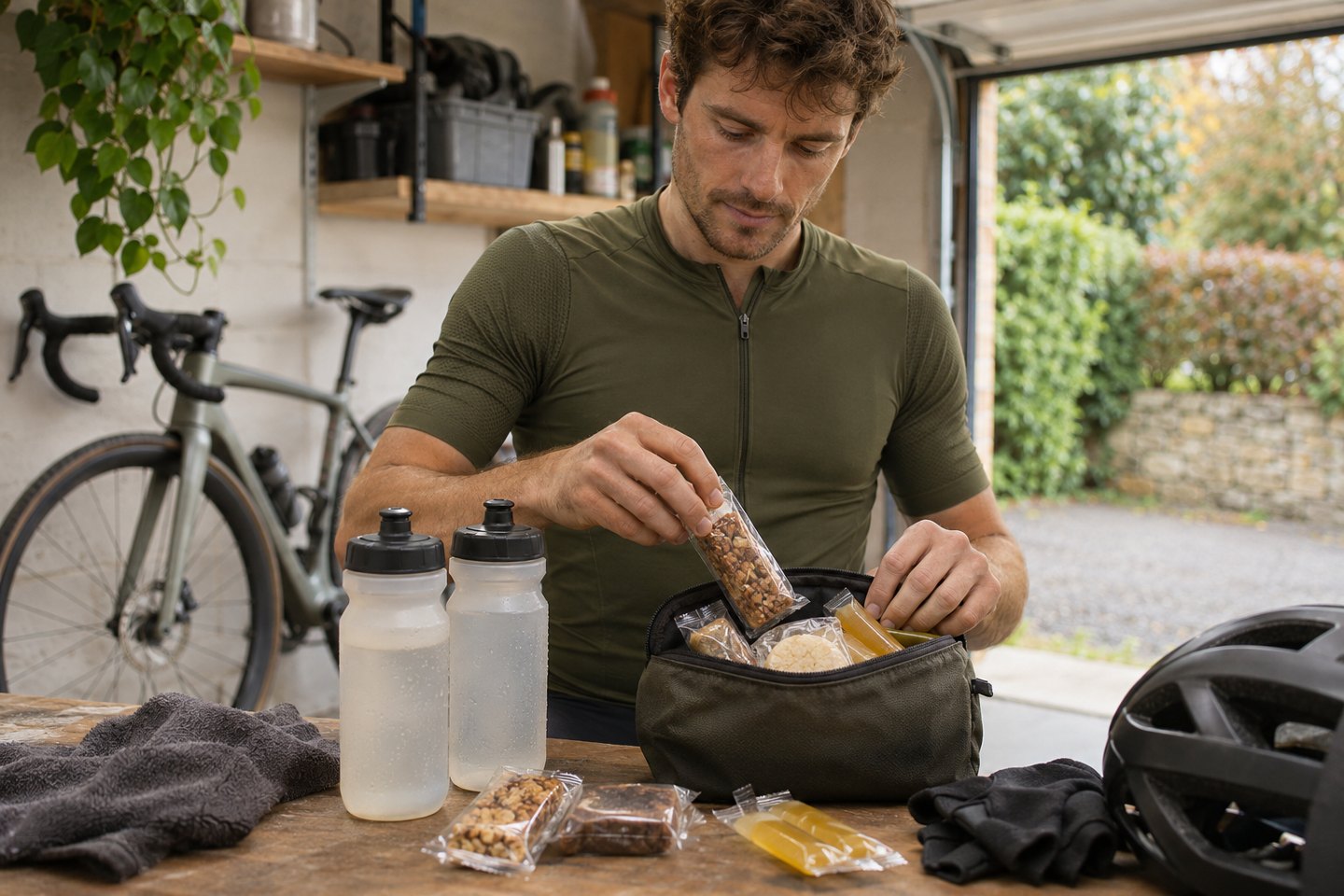
For an ultra, I’d plan the ride in blocks between reliable resupply points. Check opening hours, carry an extra portion of fuel and have something savoury in reserve if sweet foods lose their appeal. A jam sandwich, soft bar or rice cake can sit alongside gels and drink mix if you’ve tested it. Make sure you can get to the food easily, including with cold hands or in the dark. The test is whether you can still follow the plan several hours in.
What to eat between rides
After a demanding ride, I’d get a meal in with carbs, protein and fluids. That could be a rice bowl with chicken or tofu, or beans on toast with yoghurt and fruit. If you’re riding again that day or early the next morning, prioritise eating and drinking sooner. When you’ve got more time, your regular meals can do much of the work. For ideas that fit a busy week, see my nutrition guide for time-poor cyclists.
I also pay attention to how a rider is doing across the week. When training ramps up, it’s easy to keep eating the same meals out of habit, even though you’re doing more work. Over time, consistently taking in too little energy relative to training can affect health and performance in both women and men. If you’re dealing with persistent fatigue, recurring injuries or changes to your menstrual cycle, speak with a healthcare professional or sports dietitian.
My five cycling nutrition for amateur cyclists tips
If you’ve got a sportive, Gran Fondo, or an ultra coming up, pick a ride where you can practise before it matters. Here’s what I’d do:
- Decide what you’ll eat before you leave. Give yourself time to digest a familiar meal, or have a smaller snack if you’re riding soon.
- Pack for the ride you’re doing. Use the effort and duration to decide how much fuel to carry, and check where you can refill.
- Choose when you’ll have your first bite. Pick a quiet stretch before the first big climb, while it’s still easy to eat.
- Write down what actually happened. Note what you ate and drank, how your stomach felt and how well you held your effort late in the ride.
- Change one thing next time. Try a different amount, timing or food so you can tell what helped.
Summary
Match your fuelling to the ride you’re doing. Eat enough to support the hard work and recover afterwards, then use your longer training rides to test what you can comfortably eat and drink. By event day, you’ll have a plan you’ve already used when the ride gets hard.
If you want help turning these principles into a practical plan for your training and event, we can talk through what fits your ride. Book a Free Consultation.
Further reading
- How to fuel for sportives and gran fondos for building and rehearsing an event-day nutrition plan.
- How to personalise your hydration for thinking through your fluid needs on and off the bike.
- How to qualify for and complete Paris–Brest–Paris for preparing for a ride that takes you through the night.
Research and position statements
- Burke et al. (2026) bring together the UCI project’s recommendations on fuelling, recovery and rider health. UCI position statement on nutrition for cycling · PubMed abstract
- The UCI road racing review explains how professional race demands shape carbohydrate intake. Race nutrition for road cycling
- Thomas, Erdman and Burke (2016) cover carbohydrate intake before and during exercise, plus nutrition for recovery. Nutrition and athletic performance
- This 2023 systematic review looks at whether practising eating and drinking during endurance exercise can improve gut comfort and tolerance. Gut training and feeding during endurance exercise
- Cheung et al. (2026) look at fuelling and hydration in heat, cold and at altitude. UCI review on special environments
- Mountjoy et al. (2023) explain how low energy availability can affect health and performance. IOC consensus statement on Relative Energy Deficiency in Sport